


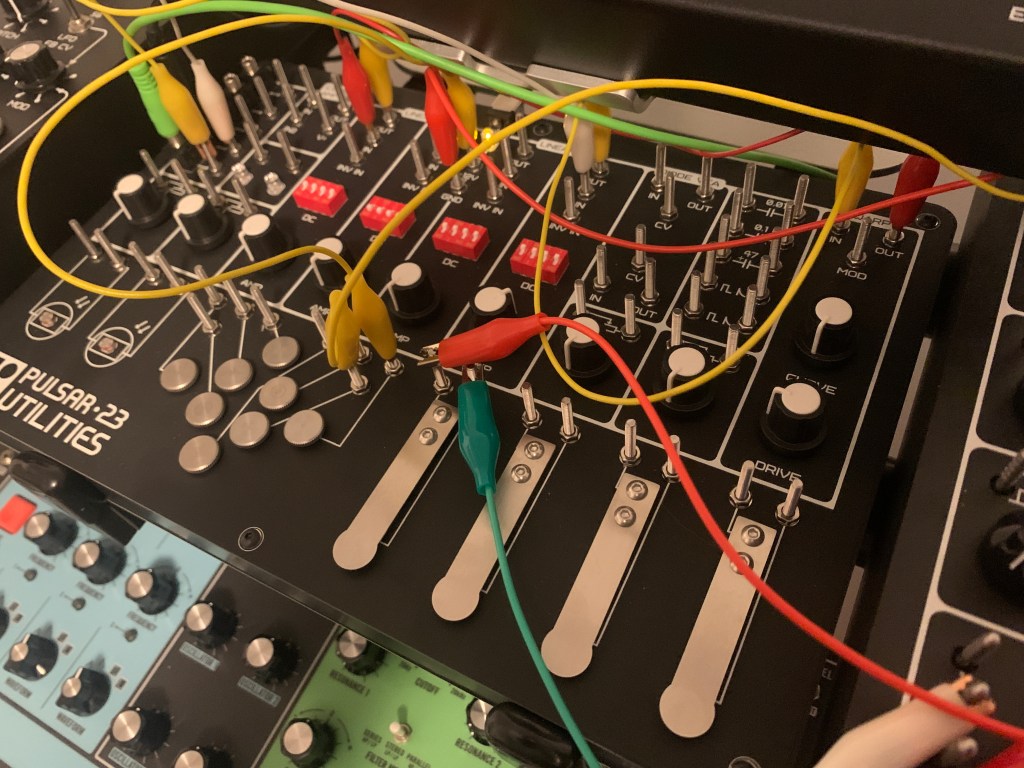
The goal of this session was to explore using the empress ZOIA euroburo to process audio and to experiment with the pulsar utilities as an audio processor and control surface. The Lyra is played manually while the pulsar is played through the utilities with a mixture of random note generation and looping.
—LYRA—
Lyra 8 tuned very roughly to E minor. Upper 4 voices one octave higher.
[E F# G A ][B C D E]8va
50% sharpness per voice – Lots of sharpness to create harmonics to be distorted by utilities warp. Lots of built in delay, slow/fast envelope toggles used during performance.
Lyra audio signal comes into utilities, and is then amplified by a linear amp in all AC mode to drive the warp circuit a bit harder. I experimented with different dip switch positions because there was no documentation in the manual about them, mixing different AC/DC configurations shapes the signal amplitude in different ways dynamically.
The warp circuit is then modulated manually during performance, different levels of drive and curve interact to asymmetrically clip the signal creating a sort of highpass distortion effect. I need to experiment with the mod pin of this circuit more in the future.
From there the Lyra is processed through stacks of phaser, reverb, delay, and more reverb for dimension and spectral smear. The Lyra signal is converted to stereo by the FX chain.
ZOIA Phaser 30% mix 8 pole phaser
ZOIA Ghostverb 30% mix 0.5 feedback and resonance
Source Audio Nemesis delay analog mode 30% mix 50% delay and feedback
Eventide Space Hall 40% mix 2.6s decay
Lyra signal path
Lyra w/ delay → utilities linear amp → utilities warp → utilities linear amp → ZOIA phaser → ZOIA ghost verb → source audio nemesis → eventide space
—ZOIA—
ZOIA is used as an audio processor as already discussed, midi note generator, and CV looper. The ZOIA is controlled primarily with a pair of the utilities CV touchpads and a momentary CV switch.
Each time the CV touchpad circuit is closed with +10V a random midi note with random velocity quantized to the E minor scale is played
Utilities +12V →Touchpad → ZOIA CV IN 3 → Random value on Trigger
→ MIDI Note Velocity
→ Quantizer CV Input (E Minor) → MIDI Note Out
The quantized CV values are sent directly to the Pulsar and played in realtime, but also sent to a pair of CV looper modules with 16s recording buffers. One looper records the quantized pitch CVs, and the other records the CV voltage spikes created by the CV touchpads. The playback speed of the loopers is modulated by a sinewave LFO to create variation. The loopers playback continuously unless the momentary switch on the utilities is depressed, this puts them in record mode and any notes played are added to the buffer, or the existing buffer can be overwritten with silence.
Pulsar Square Wave LFO high rate (makeshift static +5V source) → Utilities momentary switch → ZOIA CV IN 1 → Looper 1/2 record/playback mode switch
Quantizer CV out → CV Looper Melody → MIDI Out
ZOIA CV IN 3 → CV Looper Gate → MIDI Out
—Pulsar—
Bass module triggered by ZOIA / utilities as previously described. Bass module receives LFO modulation from ZOIA on LPF Cutoff and Warp.
FX in true stereo mode, stereo delay using +10V applied to MAD!/stereo pin. This only works with the DBL mode. Signal converted to stereo dual 1/4” from reverb and delay output pins and send to Cosmos in short granular mode. Moderate amounts of blur, drift, feedback, and suppression used during performance.
Audio recorded directly into iPhone XR via iConnectAudio4+ interface.
 bombmotion